Looking Beyond Platforms
Why You Need a Guide to Successfully Adopt AI in Your Company
By: Gabriel Simonet | Chief Marketing Officer, GeneXus, a Globant Company
July 2026
Our thesis is simple: a company becomes stronger when it identifies and attacks its weak links, its bottlenecks, one by one.
When the engineering team accelerates 10x, the bottleneck can shift to marketing. When product prototypes in hours, the bottleneck moves to legal. When customer support brings in agents, the workload can shift to governance. AI does not eliminate bottlenecks. It moves them.
That is why successfully adopting AI requires more than technology. It requires redesigning how we work, thanks to AI and because of it, with people, processes, and tools. It requires governance. It requires experience. And where it does not require it outright, it at least calls for a guide who has already walked the path.
Platforms can be bought. The ability to detect weak links has to be learned.
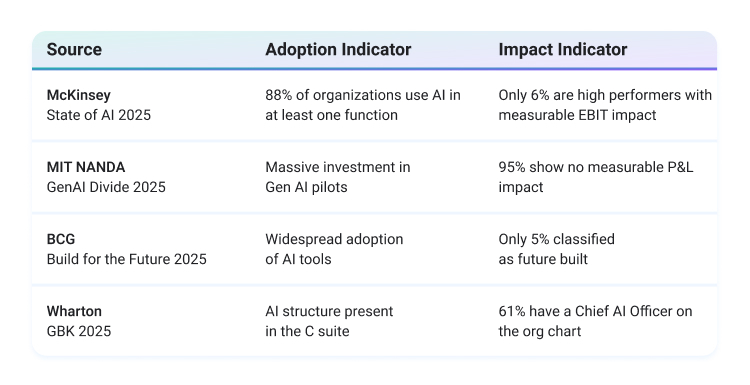
Usage is there. Investment is there. The title is on the org chart. And yet, the results don't always show up.
Our hypothesis for this whitepaper draws on the model developed by Chad Jones (Stanford): many companies automate isolated parts and don't see the benefits, because the system's real bottlenecks simply move to other parts of the process.
An organization is a chain. It doesn't get stronger because one link gets stronger. It gets stronger when it attacks its weak links, one by one. For AI to work, it has to be applied that way: systemically, not piecemeal.
That capability is organizational, not technical. And most companies cannot assemble it alone.
The right question is:
Which weak link are we going to detect and attack this week, this month, this quarter?
AI comes to remove another bottleneck: the moment an idea becomes something concrete, communicable, distributable. A text. An image. A prototype. A presentation. A proposal. A workflow.
When creation becomes cheap, value shifts. Producing more is no longer enough. You need to know what to produce, with what intent, from what identity, in what sequence, and how the process continues afterward in order to capture the benefits of that production.
AI helps us move faster. But if we don't define where we want to go, we arrive sooner at the same place as everyone else.
Differentiation comes from "using AI" to amplify what the organization uniquely knows how to do. The better an organization knows itself, its processes, its users, its systems, how it communicates, its markets, the better it will be able to differentiate itself.
If engineering builds a feature in a day and marketing needs a week to communicate it, marketing becomes the bottleneck. If product prototypes in hours and legal takes two weeks to process it, legal is the bottleneck. If sales generates proposals in minutes and compliance takes days to review them, compliance is the bottleneck.
It doesn't matter if a developer moves at 100x if the rest of the organization moves at 1x.
When AI accelerates software construction 10x or 100x, everything else becomes slow by comparison.
Automating a task that represents 2% of your costs can produce a huge improvement in that task. But the other 98% remains untouched. Local efficiency does not guarantee systemic transformation.
AI creates value when it's used to find and attack the next bottleneck, not when it settles for celebrating the first one.
These four lines of thinking come from independent observations, but they converge on the same conclusion: adopting AI requires orchestrating the entire organization so that no single area chokes the progress of the others.
Creating more, faster, and cheaper loses its meaning if the result is generic. Every new capability must be used with intent: to amplify the company's identity, strengthen its operational knowledge, and accelerate what makes it distinct.
The strategic challenge lies in systematically detecting and attacking the next weak link. That is where AI stops being just another tool and becomes an engine of competitive advantage.
But those parts don't exist in isolation. When one accelerates, it redefines how the rest of the work is organized around it. It changes what we expect from a team, what we consider slow, who gets to participate, and how decisions get coordinated.
That's why the real change shows up in how we work: fewer handoffs and more prototypes, fewer rigid roles and more augmented generalists, less coordination through meetings and more coordination around living artifacts.
That is where AI native transformation begins.
In the AI native model, the prototype becomes the common language. It's built in hours, shared, and discussed around something visible. Business, design, development, marketing, legal, and the client stop imagining different things.
The spec stops being a dead document. It starts being something you can test.
Specialization doesn't disappear. But the value of generalists who can connect the dots rises again.
That means changing how decisions get made, how things get documented, how work gets coordinated, how learning happens, how performance gets measured, and how things scale. The tool matters, but the way of working matters more.
If only one changes, it isn't enough.
New roles emerge: adoption leaders, agent specialists, hybrid workforce managers, governance owners, reusable asset owners.
There's also a risk that gets little attention: many of the tasks that used to train junior employees are the first ones AI absorbs. The marketing junior used to learn by writing hundreds of mediocre copy drafts. The developer, by fixing simple bugs. The finance junior, by building basic models.
If those tasks disappear without redesigning how mentoring works, the company gains efficiency today and loses capability tomorrow.
Automating junior work without redesigning how people learn and grow in the age of AI is mortgaging the future.
First, shared context. The faster things move, the more it matters that decisions, learnings, and criteria stay visible. Writing stops being bureaucracy and becomes executable knowledge, a kind of infrastructure.
Second, abundant exploration. The marketer who used to test one variant now tests ten. The designer who used to produce three options now explores seven. Sales can prepare five proposals and pick the best one.
Third, speed as a decision. Every recurring meeting must justify its existence. Every approval must justify its delay. Every handoff must prove it adds value.
Governed: meaning traceability, cost control, versioning, permissions, evaluation, observability, and secure operation. The opposite of that isn't innovation, it's shadow AI.
Owned: this doesn't mean building everything from scratch. It means adapting, systematizing, and accumulating assets: agents, prompts, skills, memories, standards, documentation, project logs, reusable workflows.
If the tools change but the processes don't, there is no transformation. If the tools and processes change but the people don't, there is frustration. If the people change but the platforms don't, there are heroes. And heroes don't scale.
Success with AI depends on the whole chain, not on a single link.
A major advantage is the ability to detect and attack weak links in how you work before your competitors do.
And when done well, that advantage is hard to copy, because it depends on your business, your data, your customers, your culture, your systems, and your history. AI commoditizes tasks. The strategy of attacking your weak links with AI and your own knowledge does not get commoditized.
Why? Because jobs are bundles of tasks. AI can automate many of a radiologist's tasks, but not the entire bundle: clinical context, legal responsibility, interaction with physicians, integration of signals, professional judgment.
The AI augmented radiologist can be worth more than before.
But not every job behaves that way. In some cases, AI doesn't take parts of the bundle, it takes the whole bundle. The strategic question becomes necessary:
Is your business one where AI empowers humans, or one where AI can absorb almost the entire operation?
A poorly governed agent can leak sensitive information. A workflow without evaluation can amplify errors. Automation without clear permissions can execute actions outside of policy. AI democratizes creation, but it also democratizes new risk vectors.
That's why governance isn't bureaucracy. It's a necessary condition for scaling.
A company's operational identity is not what it states in its values. It's what it learns while detecting and attacking its own weak links. That identity, built up over time through processes, assets, styles, and judgment, is what competitors cannot copy just by buying the same platform.
A company can buy the best platform on the market and still not understand the weak link problem. Or understand it, and still take months to find bottlenecks that someone with experience would spot in weeks.
GeneXus has spent more than 35 years simplifying software development, building platforms, and supporting companies around the world in creating and maintaining mission critical systems.
In 2022, Globant acquired GeneXus to integrate it into its products division, consolidating a unique proposition: the software development platform with the longest track record in the region and in Asia, within one of the largest digital transformation companies in the world.
Today, both companies are internally living through the same AI native transition they propose to their clients: AI adoption, cultural change, frequent prototyping, redesigned processes, agents, captured knowledge, and proprietary platforms.
The GeneXus partner network brings closeness, regional trust, and deep knowledge of local businesses.
Globant brings enterprise scale, experience transforming complex organizations, and execution capability in regulated industries.
Together they form an ecosystem capable of supporting any type of company, anywhere in the world, in adopting AI. Regardless of size, location, or industry.
Why do we say "sherpas"? The metaphor comes from Martín Migoya, co founder and CEO of Globant, who has said that adopting AI "requires a sherpa." A sherpa doesn't sell you climbing gear. Nor does he lecture you about the theory of altitude. A sherpa walks with you, knows the terrain, anticipates the dangers, and knows exactly what to do when something goes wrong. His value lies in the accumulated experience of having made that journey many times.
And that is our mission: to help companies successfully navigate this AI adoption journey, ahead of their competitors.
This is the natural entry point into a path of four services that cover the full journey, from initial diagnosis to installing the AI native operating model. It's designed so you enter at the point that matches your AI maturity.
From the first session you will come away with:
The conversation is with teams that have already gone through this transition in highly complex organizations. Operational experience, not just sales material.
Book your AI Opportunity Map session
The conversation is with teams that have already gone through this transition in highly complex organizations. Operational experience, not just sales material.
Book your session
July 2026
Executive Summary
Adopting Artificial Intelligence has become a matter of competitive survival. But within that adoption, an uncomfortable paradox emerges. Many companies that are already investing, testing tools, and creating AI leadership roles are not capturing the impact they expected. The problem is not a lack of platforms, but a lack of ability to detect where else changes need to happen so that AI truly transforms the way we work.Our thesis is simple: a company becomes stronger when it identifies and attacks its weak links, its bottlenecks, one by one.
When the engineering team accelerates 10x, the bottleneck can shift to marketing. When product prototypes in hours, the bottleneck moves to legal. When customer support brings in agents, the workload can shift to governance. AI does not eliminate bottlenecks. It moves them.
That is why successfully adopting AI requires more than technology. It requires redesigning how we work, thanks to AI and because of it, with people, processes, and tools. It requires governance. It requires experience. And where it does not require it outright, it at least calls for a guide who has already walked the path.
Platforms can be bought. The ability to detect weak links has to be learned.
1. The Paradox: Everyone Uses AI, Few Capture Value
AI adoption looks massive. The impact, considerably less so.Usage is there. Investment is there. The title is on the org chart. And yet, the results don't always show up.
Our hypothesis for this whitepaper draws on the model developed by Chad Jones (Stanford): many companies automate isolated parts and don't see the benefits, because the system's real bottlenecks simply move to other parts of the process.
An organization is a chain. It doesn't get stronger because one link gets stronger. It gets stronger when it attacks its weak links, one by one. For AI to work, it has to be applied that way: systemically, not piecemeal.
That capability is organizational, not technical. And most companies cannot assemble it alone.
The right question is:
Which weak link are we going to detect and attack this week, this month, this quarter?
2. Four Ideas That Change the Conversation
There are four observations that, taken together, change the way we think about AI adoption.1. Ben Thompson: When Creation Stops Costing Anything
For Ben Thompson (technology analyst and founder of Stratechery), the history of communication is a succession of bottlenecks that were gradually removed. Writing unlocked consumption. The printing press unlocked duplication. The internet unlocked distribution.AI comes to remove another bottleneck: the moment an idea becomes something concrete, communicable, distributable. A text. An image. A prototype. A presentation. A proposal. A workflow.
When creation becomes cheap, value shifts. Producing more is no longer enough. You need to know what to produce, with what intent, from what identity, in what sequence, and how the process continues afterward in order to capture the benefits of that production.
2. The Risk of Homogenization
If we all access the same models, trained on similar data, using similar tools, a quiet risk emerges: sounding alike, deciding alike, building alike.AI helps us move faster. But if we don't define where we want to go, we arrive sooner at the same place as everyone else.
Differentiation comes from "using AI" to amplify what the organization uniquely knows how to do. The better an organization knows itself, its processes, its users, its systems, how it communicates, its markets, the better it will be able to differentiate itself.
3. Andrew Ng: The Bottleneck Migrates
Andrew Ng, co founder of Google Brain and one of the architects of the modern deep learning boom, puts it plainly: the bottleneck doesn't disappear with AI. It migrates.If engineering builds a feature in a day and marketing needs a week to communicate it, marketing becomes the bottleneck. If product prototypes in hours and legal takes two weeks to process it, legal is the bottleneck. If sales generates proposals in minutes and compliance takes days to review them, compliance is the bottleneck.
It doesn't matter if a developer moves at 100x if the rest of the organization moves at 1x.
When AI accelerates software construction 10x or 100x, everything else becomes slow by comparison.
4. Chad Jones: The Economics of Weak Links
Chad Jones, an economist at Stanford and one of the leading theorists of modern growth economics, offers an insight that complements Ng's observation perfectly: an economy, a company, or a system doesn't transform by endlessly improving a single part. It transforms when it improves its weak links in sequence.Automating a task that represents 2% of your costs can produce a huge improvement in that task. But the other 98% remains untouched. Local efficiency does not guarantee systemic transformation.
AI creates value when it's used to find and attack the next bottleneck, not when it settles for celebrating the first one.
These four lines of thinking come from independent observations, but they converge on the same conclusion: adopting AI requires orchestrating the entire organization so that no single area chokes the progress of the others.
Creating more, faster, and cheaper loses its meaning if the result is generic. Every new capability must be used with intent: to amplify the company's identity, strengthen its operational knowledge, and accelerate what makes it distinct.
The strategic challenge lies in systematically detecting and attacking the next weak link. That is where AI stops being just another tool and becomes an engine of competitive advantage.
3. What Really Changes When AI Enters in Earnest
As we've seen, when a new tool enters an organization, it doesn't change the whole process at once. It first changes some parts: a task, a function, a moment in the workflow. We automate piece by piece.But those parts don't exist in isolation. When one accelerates, it redefines how the rest of the work is organized around it. It changes what we expect from a team, what we consider slow, who gets to participate, and how decisions get coordinated.
That's why the real change shows up in how we work: fewer handoffs and more prototypes, fewer rigid roles and more augmented generalists, less coordination through meetings and more coordination around living artifacts.
That is where AI native transformation begins.
From Handoff to Prototype
In the traditional model, work moves forward through handoffs: brief, design, development, QA, marketing, legal, sales. Each step loses context. Each handoff adds friction.In the AI native model, the prototype becomes the common language. It's built in hours, shared, and discussed around something visible. Business, design, development, marketing, legal, and the client stop imagining different things.
The spec stops being a dead document. It starts being something you can test.
The Revival of the Augmented Generalist
AI shrinks the distance between understanding a discipline and being able to execute something in it. Strong specialists remain critical, but more hybrid profiles emerge: marketers who prototype, designers who explore logic, PMs who build demos, salespeople who prepare several versions of a proposal and choose the one that connects best.Specialization doesn't disappear. But the value of generalists who can connect the dots rises again.
The Transformation Is Organizational
An AI native organization works differently thanks to AI.That means changing how decisions get made, how things get documented, how work gets coordinated, how learning happens, how performance gets measured, and how things scale. The tool matters, but the way of working matters more.
4. Three Levers: People, Processes, and Tools
Redesigning how we work requires moving three levers at the same time: People, Processes, and Tools.If only one changes, it isn't enough.
People
AI native teams tend to be smaller, denser, and more multidisciplinary. They combine business, design, development, data, AI, and operations around concrete problems.New roles emerge: adoption leaders, agent specialists, hybrid workforce managers, governance owners, reusable asset owners.
There's also a risk that gets little attention: many of the tasks that used to train junior employees are the first ones AI absorbs. The marketing junior used to learn by writing hundreds of mediocre copy drafts. The developer, by fixing simple bugs. The finance junior, by building basic models.
If those tasks disappear without redesigning how mentoring works, the company gains efficiency today and loses capability tomorrow.
Automating junior work without redesigning how people learn and grow in the age of AI is mortgaging the future.
Processes
There are three central moves in this area:First, shared context. The faster things move, the more it matters that decisions, learnings, and criteria stay visible. Writing stops being bureaucracy and becomes executable knowledge, a kind of infrastructure.
Second, abundant exploration. The marketer who used to test one variant now tests ten. The designer who used to produce three options now explores seven. Sales can prepare five proposals and pick the best one.
Third, speed as a decision. Every recurring meeting must justify its existence. Every approval must justify its delay. Every handoff must prove it adds value.
Tools
The AI stack must be governed and owned.Governed: meaning traceability, cost control, versioning, permissions, evaluation, observability, and secure operation. The opposite of that isn't innovation, it's shadow AI.
Owned: this doesn't mean building everything from scratch. It means adapting, systematizing, and accumulating assets: agents, prompts, skills, memories, standards, documentation, project logs, reusable workflows.
If the tools change but the processes don't, there is no transformation. If the tools and processes change but the people don't, there is frustration. If the people change but the platforms don't, there are heroes. And heroes don't scale.
Success with AI depends on the whole chain, not on a single link.
5. Detecting Weak Links Is the New Differentiator
When everyone has access to the same tools, the advantage lies in knowledge, in sequencing, and in how they're used: your processes and your way of working.A major advantage is the ability to detect and attack weak links in how you work before your competitors do.
And when done well, that advantage is hard to copy, because it depends on your business, your data, your customers, your culture, your systems, and your history. AI commoditizes tasks. The strategy of attacking your weak links with AI and your own knowledge does not get commoditized.
The Radiologist Example
In 2016, Geoff Hinton (Nobel laureate and "Godfather of AI") predicted that we should stop training radiologists because AI would replace them. That prediction didn't come true. There are more practicing radiologists today, and they're better paid.Why? Because jobs are bundles of tasks. AI can automate many of a radiologist's tasks, but not the entire bundle: clinical context, legal responsibility, interaction with physicians, integration of signals, professional judgment.
The AI augmented radiologist can be worth more than before.
But not every job behaves that way. In some cases, AI doesn't take parts of the bundle, it takes the whole bundle. The strategic question becomes necessary:
Is your business one where AI empowers humans, or one where AI can absorb almost the entire operation?
The Risk Is Asymmetric
While the benefits of AI arrive gradually, the risks can arrive all at once.A poorly governed agent can leak sensitive information. A workflow without evaluation can amplify errors. Automation without clear permissions can execute actions outside of policy. AI democratizes creation, but it also democratizes new risk vectors.
That's why governance isn't bureaucracy. It's a necessary condition for scaling.
A company's operational identity is not what it states in its values. It's what it learns while detecting and attacking its own weak links. That identity, built up over time through processes, assets, styles, and judgment, is what competitors cannot copy just by buying the same platform.
6. Why You Need a Guide
Real AI adoption requires three simultaneous components:- A solid platform: governable, flexible, vendor neutral, observable, and ready for agents.
- Capable services: implementation, integration, customization, operation, and evolution.
- Experienced guidance: people who have already lived this journey and know where the weak links tend to show up.
A company can buy the best platform on the market and still not understand the weak link problem. Or understand it, and still take months to find bottlenecks that someone with experience would spot in weeks.
The GeneXus + Partners + Globant Ecosystem: A Tribe of Sherpas
Adopting AI in an organization is a transformation process that involves changing how you work, how you decide, and how you learn. And that process is hard to go through without the right support.GeneXus has spent more than 35 years simplifying software development, building platforms, and supporting companies around the world in creating and maintaining mission critical systems.
In 2022, Globant acquired GeneXus to integrate it into its products division, consolidating a unique proposition: the software development platform with the longest track record in the region and in Asia, within one of the largest digital transformation companies in the world.
Today, both companies are internally living through the same AI native transition they propose to their clients: AI adoption, cultural change, frequent prototyping, redesigned processes, agents, captured knowledge, and proprietary platforms.
The GeneXus partner network brings closeness, regional trust, and deep knowledge of local businesses.
Globant brings enterprise scale, experience transforming complex organizations, and execution capability in regulated industries.
Together they form an ecosystem capable of supporting any type of company, anywhere in the world, in adopting AI. Regardless of size, location, or industry.
Why do we say "sherpas"? The metaphor comes from Martín Migoya, co founder and CEO of Globant, who has said that adopting AI "requires a sherpa." A sherpa doesn't sell you climbing gear. Nor does he lecture you about the theory of altitude. A sherpa walks with you, knows the terrain, anticipates the dangers, and knows exactly what to do when something goes wrong. His value lies in the accumulated experience of having made that journey many times.
And that is our mission: to help companies successfully navigate this AI adoption journey, ahead of their competitors.
7. Your Next Step
If this situation resonates with you, the next step is an AI Opportunity Map session with a sherpa from the GeneXus x Globant network.This is the natural entry point into a path of four services that cover the full journey, from initial diagnosis to installing the AI native operating model. It's designed so you enter at the point that matches your AI maturity.
From the first session you will come away with:
- Non obvious weak links identified for your industry, your size, and your organizational culture.
- Opportunities prioritized by value and complexity.
- Minimum governance criteria to get started without accumulating risk.
- Initial use cases with real potential for impact.
- A recommendation for the most suitable next service.
- A support model based on size, geography, and maturity: direct from GeneXus, through a local partner, or through Globant.
The conversation is with teams that have already gone through this transition in highly complex organizations. Operational experience, not just sales material.
Book your AI Opportunity Map session
The conversation is with teams that have already gone through this transition in highly complex organizations. Operational experience, not just sales material.
Book your session